 Skip to content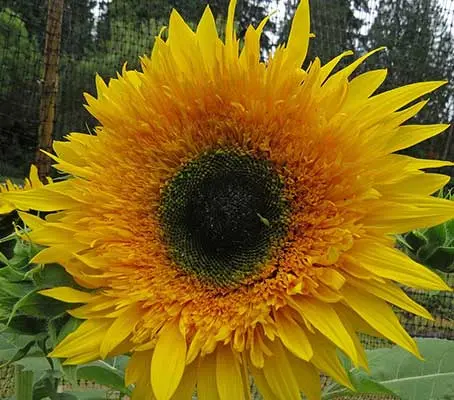



Helianthus annuus ‘Starburst Panache’
Pollenless, Premium Sunflower
€3.50
Packet Size:20 Seeds
Packet Size:20 Seeds
Starburst Panache sunflower is one of the finest double-flowered, pollen-free varieties for the cutting garden. This branching sunflower produces clouds of shaggy, golden blooms on long, strong stems, perfect for late summer arrangements and equally striking in borders alongside perennials and ornamental grasses.
Mid-sized plants of Starburst Panache branch freely, carrying fully double flowers with ultra-fluffy petals surrounding green-brown centres, creating a richly textured display from late summer into autumn. The pollen-free blooms are long-lasting, and the plants continue to produce fresh buds over many weeks, making them highly productive. They combine beautifully with rudbeckia, dahlias and airy grasses, while also attracting pollinators and, later, seed-loving birds.
Sow Starburst Panache sunflower from mid-spring to mid-summer for a continuous display, allowing around 60 to 65 days to maturity. Space plants 30 to 45cm (12 to 18in) apart; closer spacing produces smaller flowers, while wider spacing encourages larger blooms and sturdier stems. Pinching out the growing tip at around 30cm (12in) will encourage bushier plants with more flowering stems, though leaving a few unpinched will give earlier, taller blooms.
Cut the flowers when the petals begin to unfurl from the face. Blooms can last up to a fortnight when kept in water.
Pollenless Sunflowers:
Sunflowers are a hot item, originally considered to be a bit of a fad by florists. The fad never passed, in response to the call by florists and home growers, breeders produced innumerable varieties and developed a number of premium varieties that are fabulous as a cut flower, and most importantly are pollenless.
A regular cut-flower sunflower is beautiful when cut, but as the disc flowers in the centre mature, they drop pollen all over the consumer’s table, followed shortly, by the petals of the flower. A pollenless variety has sterile disc flowers, so it can produce neither pollen nor seed. Since it doesn’t produce pollen, it never decides that its natural function (seed production) has been fulfilled, and it lasts for two full weeks in the vase. The leaves will yellow and have to be removed, but the flower remains attractive for much longer.
Sowing: Mid spring to mid summer.
For early flowers, start indoors as early as February or March, or sow directly outdoors in in mid-April through to mid-May.
For continuity, sow a succession of sunflowers every fortnight for six weeks in the early part of the growing season. In a hot summer, each cycle from sowing to blooming will take about 60 days.
Sowing Indoors:
Start indoors as early as February or March, to germinate in about 10 days at 60 to 65°F and plant out in April or May. Use 7.5cm (3in) pots and a good sowing compost. Sow one seed 2.5mm (1in) deep per pot. Water and cover with either polythene or bubble plastic to retain the heat, or place pots on a heated bench or in a propagator with the temperature set at 13°C (55°F).
Remove the covers when the leaves appear. Plant seedlings outside when they are large enough to be handled and the root system is well developed. Add garden compost to the soil if it is heavy or infertile.
Sowing Direct:
Plant outside as early as possible to miss heavy frosts, to germinate in about 1 to 3 weeks, in mid-April through mid-May, after the danger of spring frost is past. Ideally, when the soil temperature has reached 13 to 16°C (55 to 60°F).
Sow the seed 5cm (2in) deep and space 45cm (18in) apart in borders. Give the plants plenty of room, especially for low-growing varieties that will branch out. Make rows about 30 inches apart. For very smaller varieties, plant closer together, around 30cm (12in) apart. You can plant multiple seeds and thin them to the strongest contenders when the plants are 15cm (6in) tall.
Experiment with plantings staggered over 5 to 6 weeks to keep enjoying continuous blooms. Water seedlings regularly and, when growing tall forms, feed sparingly with a liquid fertiliser when 60cm (2ft) high. Beware of slugs when they are still young plants and birds stealing the seeds.
Cultivation:
Once the plant is established, water deeply though infrequently to encourage deep rooting and feed sparingly with a liquid fertiliser. Avoid splashing water or fertiliser solution on the stems or leaves. It may help to build a moat in a circle around the plant about 30 to 45cm (12 to 18in) out. Over-fertilisation can cause stem breakage in the autumn especially if the heads are large.
Tall species and cultivars require support. Bamboo stakes are a good choice for any plant that has a strong, single stem and needs support for a short period of time. Remember to cap the top of the cane with any small rounded object or upturned small pot to avoid any eye injuries.
Harvesting Cut Flowers:
Handle sunflowers gently, although they may appear robust, the petals and more delicate parts may bruise. For the vase, cut the fresh flowers in the morning just after they open, but wait until the sun has dried the dew. Remove leaves that are low on the stem, leaving just two or three higher up, near the flower’s face. Place the flowers in a bucket filled with water, and leave them to stand for several hours in a cool room before placing in a vase.
Use a clean knife, a clean vase and a few drops of bleach in the water to keep it fresh. Change the water every few days. Blooms can last up to a fortnight when kept in water.
Harvesting Seed:
To dry sunflower seeds, cut the heads off when they begin to yellow at the back and hang them upside down in a dry location away from rodents and birds. Seeds ripen around the outside of the flower first; the ones in the centre will ripen last. Once dry, rub the seeds off and soak overnight in 4 litres (1 gallon) of water with 1 cup of salt in it.
Dry in a low heat, 120°C (250°F) oven for 4 to 5 hours and store in an airtight container. The black-seeded varieties are mainly for oil and birdseed. The grey and white-striped varieties are for drying and eating.
Origin:
A native of North America, Helianthus annuus, the wild sunflowers, from which all other sunflowers come, grow in prairies, dry, open areas, and along roadsides throughout North America from central Canada to northern Mexico.
A member of the Asteraceae family, sunflowers become very popular as a cultivated plant in the 18th century. The plant was initially used as on ornamental but by 1769 literature mentions sunflower cultivated by oil production. Today the sunflower is grown for crops in the Mediterranean, Eastern Europe, Argentina, India and the USA.
Artists throughout history have appreciated the sunflower’s unique splendor, and those of the Impressionist era were especially fixated on the flower.
Nomenclature:
The Latin name for Sunflower, Helianthus annuus, is taken from the Greek helios, meaning sun, and anthos, meaning flower. The Sunflower originated from South America and represented the sun to worshiping Aztec people; it was brought to Europe in the late sixteenth century.
The species name annuus was named by Linnaeus, it was the only sunflower known to him that lived for a single season, hence it was called annus which means ‘annual’, ‘yearly’ or ‘lasting a year’.
Heliotropism:
Sunflower buds and leaves turn to follow the sun from east to west each day, a response called ‘heliotropism’, and once the flowers have fully opened, they stay facing east. By facing east, sunflower heads warm up quickly with the morning sun, attracting more pollinators than if they were west-facing, and cooler. Also, remaining east-facing may protect them from possible sun-scald from the strong, afternoon sun.
| Common Name | Pollenless, Premium Sunflower |
| Family | Asteraceae |
| Genus | Helianthus |
| Cultivar | Starburst Panache |
| Species | annuus |
| Flowers | Dark eyes surrounded by layers of feathery, golden-yellow petals |
| Height | 1.2 metres (4ft) tall |
| Foliage | Lateral branching |
| Hardiness | Hardy Annual |
| Time to Sow | Mid spring to mid summer |