 Skip to content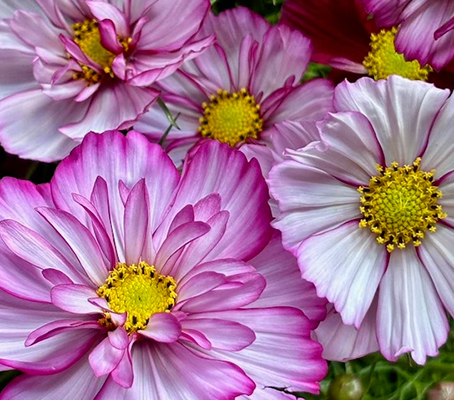





Cosmos bipinnatus ‘Fizzy Rose Picotee’
The Mexican Aster
€3.25
Packet Size:1 gram
Ave. Contents:150 Seeds
Packet Size:1 gram
Ave. Contents:150 Seeds
One of the most striking introductions to the Fizzy cosmos series, ‘Fizzy Rose Picotee’ takes the classic cosmos flower and adds a second layer of charm. The semi-double blooms open white to soft blush, with petal edges painted in a deep raspberry-red, with a true picotee effect that becomes more pronounced as the flowers mature. Growing to around 100cm on strong, well-branched stems above the usual feathery cosmos foliage, it’s as useful in a border as it is in a vase. Excellent as a cut flower, reliably floriferous from midsummer to the first frosts, and straightforward to grow from seed.
Cosmos bipinnatus, commonly called the garden Cosmos or Mexican aster, is a medium-sized flowering herbaceous plant native to Mexico. The species and its varieties and cultivars are popular as an easy to grow ornamental plant in temperate climate gardens.
They are among the easiest and most rewarding annuals you can grow from seed. Sow them, give them sun and reasonable drainage, and they’ll do the rest — flowering prolifically from midsummer right through to the first frosts with minimal attention. They actually perform better in poor to moderately fertile soil; too much richness and you’ll get plenty of leaf and fewer flowers. Deadhead regularly to keep them going, or simply let them self-seed and they’ll often return the following year. Few plants offer such a long season of colour for so little effort.
Sowing: Sow indoors March to April, or sow outdoors April to May
Sow indoors in early spring 3 to 4 weeks before planting outside, alternatively, the seed can also be sown directly where they are to flower in mid to late spring. They will take approx 70 days from sowing to flowering. Keep soil moderately moist during germination. Plant out three weeks after sowing at a 25cm (10in) on a sunny or half sunny spot.
Sowing Indoors:
Use well drained soil and cover to a depth of 3mm (1/8in). When large enough to handle, transplant the seedlings into small pots to grow on. Acclimatise to outdoor conditions for 10 to 15 days before planting out after all risk of frost 15cm (6in) apart.
Sowing Direct:
Prepare the ground well and rake to a fine tilth. If sowing more than one annual in the same bed, mark the sowing areas with a ring of sand and label. Sow 1mm (1/18th in) deep in rows 30cm (12in) apart.
Sow seed sparingly or they will choke out other seedlings.
The seedlings will appear in rows approx 6 to 8 weeks after planting and can be easily told from nearby weed seedlings. Thin the seedlings out so they are finally 25cm (10in) apart. Carefully replant thinned plants.
Cultivation:
When the seedlings have three pairs of leaves, pinch out the tips, leaving at least one pair of leaves.
Only water in an extended drought and do not apply large doses of fertiliser as flowering will be suppressed.
Stake the taller varieties with a single or tripod of canes and some twine. Cosmos foliage is finely-cut into threadlike segments. When flowering, the taller varieties may become top heavy. This problem is alleviated when grown in groups, as the bi-pinnate leaves interlock, and the colony supports itself.
Deadhead to prolong flowering and encourage new flower buds. At the season’s end, don’t be too quick to pull up withering cosmos plants. Birds (particularly gold finches) love to snack on their seedheads in autumn, and the seeds that they miss may drop to the ground and reward you the next year by sprouting into a whole new crop.
Cut Flowers:
Cosmos is a cut-and-come-again bloomer, meaning that the sooner you cut the blooms, the quicker new buds will pop up to replace them. The blooms appear so profusely that you’ll still have plenty of colour in the garden after you’ve picked your flowers.
If you sear the stem end in boiling water for twenty seconds they will last a week in water.
Plant Uses:
Cottage/Informal Gardens, Flowers Borders and Beds. Container Planting.
Nomenclature:
Cosmos have been reassuring gardeners ever since the 1930s, when breeders first coaxed cosmos to bloom earlier than the native Mexican species, the flower-growing public has been hooked.
Like many of our warm weather annuals such as marigolds, Cosmos originated in Mexico and South America. Spanish priests grew cosmos in their mission gardens in Mexico. The evenly placed petals led them to christen the flower ‘Cosmos’, derived from the Greek kosmos, the word for harmony or ordered, or balanced universe. From this we also get the common name of “The Mexican Aster”.
The species name is from the Latin bipinnatus meaning ‘twice-pinnate’ The botanical epithet is from the Latin pinnatus meaning ‘with leaflets arranged in opposite pairs’.
| Common Name | The Mexican Aster |
| Average Seed Count | 150 Seeds |
| Family | Asteraceae |
| Genus | Cosmea, Cosmos |
| Cultivar | Fizzy Rose Picotee |
| Species | bipinnatus |
| Flowers | Rich, deep purple |
| Height | 100cm (36in) |
| Spread | 40cm (16in) |
| Hardiness | Half Hardy Annual |
| Germination | 7 to 10 days at 20-30*C (68-86*F) |
| Soil | Lean, well drained, sandy soils. |
| Position | Needs full sun to flourish |
| Time to Sow | Sow indoors March to April, or sow outdoors April to May |