 Skip to content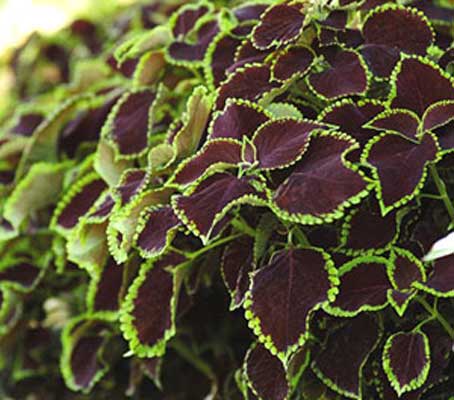

Coleus blumei, ‘Chocolate Mint’
Painted Nettle. Flame Nettle
€3.95
Packet Size:10 Pelleted Seeds
Packet Size:10 Pelleted Seeds
The prettiest and neatest Coleus to come along in quite a while, ‘Chocolate Mint’ offers rich cocoa coloured foliage with a trim mint-green scalloped edge on scrumptious, mounding plants. The leaves are very uniform, turn them over and they gleam bright mint!
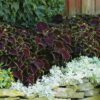
Chocolate Mint reaches 30 to 35cm (12 to 14in) high and about 25 to 30cm (10 to 12in) wide, a good size for containers or the middle of the annual border. The can create a formal look that suits porch steps and patterned beds perfectly. They are content even in full shade and quite heat and drought tolerant outdoors.
Very easy to start from seed, You will love watching the new seedlings emerge; sporting their permanent colouring from the time they are no bigger than a fingernail and display their colourful glory from the moment the tiny new leaves emerge until hard frost. The leaves are coloured and scalloped from the moment they unfurl, and they grow quickly into a well-branched, bushy little plant just ideal for containers indoors or out as well as the partly to fully shaded annual bed, So growing this coleus from seed is a delightful experience.
Coleus eventually produces woody stems and can be trained as standards. To do this, pinch out side-shoots and support the stem with a 3ft cane. When the plant reaches the desired height, pinch out the top shoot and keep removing lead shoots.
The intensity of light which the plant receives will have a direct bearing on the intensity of the foliage colouring. Some varieties of coleus may produce their best colour in light shade, while others look best in bright lighting.
Sowing: Sow all year round or in late spring for outdoor plants
Sow all year round for pot plant . For the garden, sow 10 to 12 weeks before the last expected frost , they will then be well developed when it is time to plant them outdoors.
Sow seeds onto a layer of moistened, sterile potting soil in a shallow tray, do not cover as they need light to germinate. Cover with glass or plastic to retain moisture, until the seeds have germinated. Place in a warm (21°C/ 0°F), bright (not full sun) place.
When the seedlings are large enough to handle, transplant into individual pots. Seedlings should always be held by a leaf, never by the stem.
When pricking out coleuses note that larger and stronger plants often have poorer quality foliage. When all danger of frost is past the plants may be set out in the garden. Plant 30cm (12in) apart in rich, moist, well-drained soil
Cultivation:
Pinch the centre stems out when the plants are 4 to 6 inches tall to induce bushier growth, and be sure to pick off the flower spikes as they form. For a bushy plant Continue to pinch out new shoots. Coleus is very durable, so you can cut your plant back severely if needed (almost back to the soil level).
Coleus should be kept at a 15-20°C (60-70°F) over winter. They will survive down to 10°C (50°F) but only if kept dry. Losses to rot and fungal diseases are high if the plants are allowed to get cold and damp.
Fertilise with a diluted (50% mix) liquid fertiliser, too much feeding with high nitrogen fertiliser, encourages soft growth and poorer quality foliage.
At some point it will set tiny flowers on tall stems, but these don’t do much for its looks, and can be snipped off. You don’t want anything blocking the view of those velvety chocolate-brown leaves.
Plant Uses:
Best in pots as house plants, or in the warmer conservatory, coleus can also be grown in containers or window boxes alongside other temporary summer planting. They can also look good bedded out with salvias, rudbeckias, gaillardias and other late-summer flowers in the red-yellow end of the spectrum in warm borders.
Origin:
Coleus was first recorded in India and Malaysia, where it grew wild and was used in traditional medicine. Europeans encountered it in the 1700s, and by the 19th century, hybrid varieties were being cultivated for gardens, prized for bold, patterned leaves.
The roots of coleus are known from ancient times, where it served as a stand in for Salvia divinorum, in shamanistic rituals. Most ornamental coleus is not considered toxic, though, like many plants, eating large amounts could cause mild stomach upset.
History:
Two species were in cultivation here by the 1860s, C. verschaftelti and C. blumei, and the first coloured-leaf variety appeared at a Royal Horticultural Society show in June 1861, introduced by William Bull, a nurseryman of King’s Road, Chelsea. Seven years later the RHS organised a promotional auction of new hybrids. One plant fetched 59 guineas, expensive now, but in those days was an enormous sum. (around €72 – the equivalent to roughly €9,000 today!)
Meanwhile Bull had bred about 150 varieties, of which he was marketing the best 18, cannily timing new releases to coincide with mentions of the plant in the gardening press. The breeding and propagation of sports was so frenetic that Gardener’s Chronicle of 1869 dubbed it “coleus fever”. Varieties have changed little since then and we’re still working with essentially Victorian material.
Nomenclature:
The genus name Coleus comes from Greek koleos, meaning ‘sheath’ or ‘case.’ It refers to how parts of the flower (the stamens) are fused together into a little tube or sheath. A neat bit of botany hidden in plain sight.
The species name blumei honours Carl Ludwig Blume, a botanist who worked extensively in Southeast Asia. So Coleus blumei is essentially ‘Blume’s coleus.’
Several years ago, the powers that be changed the name to Solenostemon scutellarioides but in a blatant act of taxonomic defiance, we refuse to call them anything but Coleus.
The new genus name Solenostemon comes from Greek: solen meaning ‘tube’ and stemon meaning ‘stamen.’ It describes the tubular shape of the stamens in the flowers. A very literal botanical name pointing to the flower’s structure.
The species name scutellarioides means ‘resembling Scutellaria’. It comes from Scutellaria (a genus of plants) plus -oides (which is Greek for ‘like’ or ‘resembling’). So Solenostemon scutellarioides is basically ‘Solenostemon that looks like Scutellaria.’
| Common Name | Painted Nettle. Flame Nettle |
| Botanical Name | Coleus blumei, 'Dark Chocolate' |
| Family | Lamiaceae |
| Genus | Solenostemon |
| Cultivar | Dark Chocolate |
| Species | scutellarioides |
| Spacing | Plant 30cm (12in) apart |
| Height | 30 to 35cm (12 to 14in) |
| Foliage | Chocolate-brown with scalloped edges |
| Hardiness | Tender Perennial often used as an Annual |
| Soil | Rich, moist, well-drained soil |
| Position | Full Sun or partial shade. |
| Time to Sow | Sow all year round for indoor plants or sow in late spring for outdoor plants |