 Skip to content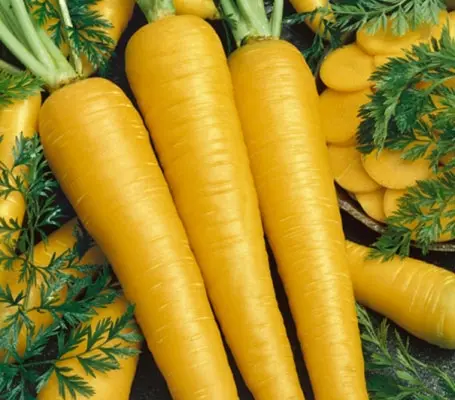




Carrot ‘F1 Yellowstone’
Maincrop
€2.95
Ave. Contents:500 Precision Seeds, Graded 1.4 to 1.6mm
Ave. Contents:500 Precision Seeds, Graded 1.4 to 1.6mm
Carrot ‘F1 Yellowstone’ is one of the most attractive and versatile carrots you can grow. Suitable for both late bunching carrots or for producing winter (storage) carrots. It’s most sought after for cooking and looks great on fresh vegetable platters. Enjoyed raw, you’ll savour Yellowstone’s classic carrot flavour.
Developed for commercial cultivation it is reliable and vigorous. It performs well across a range of soils and holds its quality in the ground without becoming woody. Slightly tapered with smooth skin and crunchy texture, this 20cm (8in) long, Nantes / Imperator type has broad shoulders and stores well in the ground when planted in late summer for winter harvest. 70 days to maturity.
Seeds can be sown successionally almost all year from February under cloches or fleece or sown directly May to July for harvesting September to end of October. The optimal harvest stage is reached when the crown diameter is generally between 20 to 30mm. In frost-free regions the carrots can spend the winter in the field and the harvest can take place gradually. In regions with cold winters, lift and store carrots in raised boxes, in a cellar or in a cold room at a temperature close to 0°C and a humidity of 95%.
The attractive golden yellow roots, add colour and flavour to salads or as a cooked vegetable where the long smooth roots hold their colour throughout the cooking process. Canary yellow through and through, honey roasted carrots have never looked, or tasted so good.
How to grow carrots:
Success with root vegetables is very much down to the quality of the soil, so it’s worth taking the time to prepare your patch. Start digging over your soil in late winter or early spring, removing any stones you find and turn the soil until it has a fine, crumbly texture. If your soil is not ideally suitable, you can prepare a large container instead. Do not add manure as this makes the soil too rich for the seeds. Too much nitrogen will cause the carrots to grow hairy little roots all up and down the carrot.
Carrots sown in February in a cold frame/cloche are ready to harvest by June. Put a cloche in place a month before sowing as this helps to warm up the soil.
Sowing: Sow successionally from February
Carrot seed sown early in February in a cold frame/cloche will be ready to harvest by June. Put the cloche in place a month before sowing as this helps to warm up the soil. Sowing into modules is another way to obtain early cropping. Sowing in early spring to early summer will hopefully avoid the most harmful hatchings of the carrot fly.
Sow the seed thinly into drills 2cm ( ¾in) deep. The rows should be spaced at 12 to 15cm (5 to 6in) apart for optimum performance. The seeds are small, but it’s wise to plant them as thinly as possible. This reduces the amount of thinning necessary and potential risk from pests. Mix the seeds with a handful of sharp sand and sow them together. Sand will also aid drainage.
Once the seedlings are showing their first rough leaves, thin out to 7 to 10cm (3 to 4in) apart which minimises competition and enables the carrots to grow quickly to harvest size.
It is best to thin seedlings in the evening when carrot fly are not around, as it’s the odour of bruised leaves which attracts them.
Cultivation:
Use a lightweight fleece over the bed to increase the temperature of the soil while also preventing the carrot flies from laying their eggs. The plants need little other attention during their growth period, although the plants should be kept well watered – too little water results in coarse, woody roots.
Harvesting: Matures in 70 to 80 days.
Start lifting the roots as soon as they are big enough to eat. It’s best to harvest them in the evening to avoid attracting carrot fly. Late-sown seedlings must be lifted by October to be stored over the winter.
Storing:
Store only the best, undamaged roots, cut off their foliage and lay the roots between layers of sand in a strong box, ensuring that the roots do not touch. Store somewhere cool and dry, check the carrots occasionally, removing any odd rotten roots before they infect their neighbours. Carrot tops can be used in a variety of dishes, including raw in drinks or in salads.
Carrots are an excellent source of the deep yellow carotenoids that produce vitamin A. They are also a good source of magnesium, potassium, vitamins C and B complex, and a form of calcium that is easily absorbed by the body.
During the first five months of storage, carrots will actually increase their vitamin A content; and, if protected from heat or light, can hold their nutrient content for another two or three months
Pests:
Carrot fly is drawn to carrots by the smell of crushed foliage, reduce the risk of an attack by thinning plants in the evening on a still day, removing any thinnings and watering afterwards. Carrot fly are also low-flying insects: erecting a ‘wind-break’ style shield around a crop will also help deter these pests.
Companion Plants:
They do well alongside most plants, especially Chives, Garlic, Rosemary and Sage (which deter Carrot Fly).
However Dill, Coriander and other members of the Umbelliferae family should not be planted near as they tend to cross pollinate which can be important if you are to save your own seed.
Carrot History:
Carrots originated in what is now Afghanistan, Iran, and Pakistan and by about 1000 A.D., they were being grown from India to the Eastern Mediterranean. By the 1300s, purple and yellow varieties had spread as far as western Europe and China. Red varieties originated in India, China, and Japan in the 1700s. White and orange carrots first appeared in Europe during the 1700s.
Due to the influence of patriotic Dutch growers who, in the sixteenth century bred orange varieties to honour their national colours, which quickly displaced all other colours and dominate the world to this day. Modern agribusiness narrowed our choices even further.
Coloured Carrots:
Plant pigments perform a range of protective duties in the human body, which is not surprising, since many of the pigments serve to shield plant cells during photosynthesis. Generally speaking the more colour in the carrot the higher the content of beta-carotene and vitamins.
Red varieties derive their colour mainly from lycopene, a type of carotene believed to guard against heart disease and some cancers.
Yellow varieties accumulate xanthophylls, pigments similar to beta-carotene that support good eye health.
Purple varieties possess an entirely different class of pigments—anthocyanins—which act as powerful antioxidants.
| Common Name | Maincrop |
| Average Seed Count | 500 Precision Seeds, Graded 1.4 to 1.6mm |
| Family | Apiaceae |
| Genus | Daucus |
| Cultivar | Yellowstone F1 |
| Species | Carota ssp. sativus |
| Spacing | Thin the seedlings to 5 to 7cm (2 to 3in) between plants. |
| Hardiness | Hardy Biennial |
| Germination | 15 to 20 days |
| Harvest | Start pulling up your carrots as soon as they are big enough to eat |
| Time to Harvest | A mid-early variety with 130 day cycle |
| Time to Sow | Sow successionally from Feb under cloches or fleece |